Phuket Ferry Booking 2026: Schedules, Times & Tickets from Phuket Ferry Terminal
The direct route from Phuket to Koh Phi Phi operates daily from Rassada Pier to Tonsai Pier. Passengers can choose a 2-hour standard ferry starting at 650 THB, or a 1-hour fast speedboat from 900 THB. Review the updated 2026 timetables and book tickets online to guarantee your seats.
Secure your Thailand phuket ferry booking directly with us to guarantee:
Guaranteed Seat Confirmation: No waiting, no uncertainty.
Best Phuket Ferry Price: Transparent rates for ferries and speedboats.
Secure Online Checkout: Fast, safe, and reliable payment.
Secure your seats online today, vessels often reach full safety capacity, and walk-in cash tickets are not guaranteed.
Enjoy peace of mind if your plans change.This ticket includes one free amendment, provided it is made at least 48 hours prior to departure and subject to seat availability.
Your first amendment is free.No amendment fee applies.
Secure Your Seats:Pre-booking your tickets online via RassadaPier.Net is highly recommended. Our most popular island routes consistently sell out year-round, so reserving in advance is the only way to guarantee your spot.
🛥️ Phuket Ferry Quick Facts 2026
Main Departure Port:Rassada Pier (Phuket Ferry Terminal), located 15 mins from Phuket Old Town.
Top Destinations:Koh Phi Phi (1-2 hours), Krabi / Ao Nang (1.5-3 hours), and Koh Lanta (1.5-4 hours).
Vessel Types:Standard AC Ferries (stable, better for large luggage) and Fast Speedboats (quickest transit).
Starting Price:From 650 THB per adult (Phuket to Koh Phi Phi standard ferry).
Boarding Rule:Passengers must check-in at least 45 minutes before departure. E-tickets are accepted.
Ferry to Koh Phi Phi from Phuket: 2026 Schedules & Tickets
Choosing a Phuket-to-Phi Phi service requires more than comparing departure times. The services shown here depart from Rassada Pier, Phuket’s main ferry terminal. For the 2026 timetable, ferry departures are published at , , , and , depending on the operator and arrival pier. Before booking, confirm the vessel type, fare, seat availability, and whether the selected service arrives at Tonsai Pier or Laemtong Beach.
*Booking Advice: Advance online booking via RassadaPier.Net is strongly recommended, as these departures frequently reach full capacity.
2026 Phuket Ferry Route Facts
“
45.3 km distance - Phuket ferry from Rassada Pier to Phi Phi Tonsai Pier: direct sailing from 650 THB/person. Our updated 2026 Phuket ferry schedule makes planning easy with daily departures. We partner with authorized and highly rated ferry operators, including Andaman Wave Master, Phi Phi Cruiser, Chao Koh Group, and Phi Phi Logistic, to support a safe and comfortable transfer. You can quickly reserve your preferred departure online.
Ted Li, Head of Product Operations, RassadaPier.Net
Departure - Arrival
Boat Type
Drop-off Point
Price
Action
08:30 - 10:30(2h)
🔥 Popular
📍 Rassada Pier ➔ Koh Phi Phi (Tonsai Pier)
⛴️Ferry Boat
Koh Phi Phi (Tonsai Pier)
💰฿650/ Adult
11:00 - 13:00(2h)
🔥 Popular
📍 Rassada Pier ➔ Koh Phi Phi (Tonsai Pier)
⛴️Ferry Boat
Koh Phi Phi (Tonsai Pier)
💰฿650/ Adult
13:30 - 15:30(2h)
🔥 Popular
📍 Rassada Pier ➔ Koh Phi Phi (Tonsai Pier)
⛴️Ferry Boat
Koh Phi Phi (Tonsai Pier)
💰฿650/ Adult
13:45 - 15:45(2h)
🔥 Popular
📍 Rassada Pier ➔ Koh Phi Phi (Tonsai Pier)
⛴️Ferry Boat
Koh Phi Phi (Tonsai Pier)
💰฿650/ Adult
15:00 - 17:00(2h)
🔥 Popular
📍 Rassada Pier ➔ Koh Phi Phi (Tonsai Pier)
⛴️Ferry Boat
Koh Phi Phi (Tonsai Pier)
💰฿650/ Adult
2026 Fast Speedboat Timetables: Phuket to Koh Phi Phi
Maximize your island time with a direct speedboat to Koh Phi Phi from Phuket. Departing from the main Phuket Ferry Terminal, our updated 2026 speedboat schedule features daily departures at , , , , , and . We highly recommend booking online to guarantee your seats on these fast, high-demand crossings.
Departure - Arrival
Boat Type
Drop-off Point
Price
Action
08:45 - 09:45(1h)
⚡ Fastest
📍 Rassada Pier ➔ Koh Phi Phi
🚤Speedboat
Koh Phi Phi (Tonsai Pier)
💰฿900/ Adult
09:30 - 10:30(1h)
⚡ Fastest
📍 Rassada Pier ➔ Koh Phi Phi
🚤Speedboat
Koh Phi Phi (Tonsai Pier)
💰฿900/ Adult
10:30 - 11:30(1h)
⚡ Fastest
📍 Rassada Pier ➔ Koh Phi Phi
🚤Speedboat
Koh Phi Phi (Tonsai Pier)
💰฿900/ Adult
11:30 - 12:30(1h)
⚡ Fastest
📍 Rassada Pier ➔ Koh Phi Phi
🚤Speedboat
Koh Phi Phi (Tonsai Pier)
💰฿1000/ Adult
12:30 - 13:30(1h)
⚡ Fastest
📍 Rassada Pier ➔ Koh Phi Phi
🚤Speedboat
Koh Phi Phi (Tonsai Pier)
💰฿1000/ Adult
13:00 - 14:00(1h)
⚡ Fastest
📍 Rassada Pier ➔ Koh Phi Phi
🚤Speedboat
Koh Phi Phi (Tonsai Pier)
💰฿900/ Adult
13:30 - 14:30(1h)
⚡ Fastest
📍 Rassada Pier ➔ Koh Phi Phi
🚤Speedboat
Koh Phi Phi (Tonsai Pier)
💰฿1000/ Adult
14:00 - 15:00(1h)
⚡ Fastest
📍 Rassada Pier ➔ Koh Phi Phi
🚤Speedboat
Koh Phi Phi (Tonsai Pier)
💰฿900/ Adult
15:30 - 16:30(1h)
⚡ Fastest
📍 Rassada Pier ➔ Koh Phi Phi
🚤Speedboat
Koh Phi Phi (Tonsai Pier)
💰฿900/ Adult
Phuket Boat Comparison
Phuket Ferry vs. Speedboat: Which is right for you?
Operational recommendation
“Based on our daily work coordinating ferry and speedboat bookings from Rassada Pier, we generally recommend the Standard Ferry for passengers who prioritize a steadier ride, more cabin space, greater luggage capacity, and lower fares. We recommend the Fast Speedboat for passengers whose main priority is the shortest crossing time.”
— Ted Li, Head of Product Operations, RassadaPier.Net
First-hand guidance based on daily passenger booking and departure coordination at Rassada Pier. Reviewed for the 2026 schedule on 9 September 2026.
Actual travel times and luggage limits may vary by route, vessel, operator, and departure date.
Comfort & value01
Standard Ferry
Travel time Depending on destination 2–4 hours
Advantages
Generally steadier than a speedboat, with air-conditioned cabins, spacious seating, more room for larger suitcases, and lower ticket prices.
Consider
The crossing takes longer, so this option is better when comfort and value matter more than speed.
Shortest crossing02
Fast Speedboat
Travel time Depending on route 1–1.5 hours
Advantages
The fastest option for reaching the islands, leaving more time at your destination.
Consider
The ride can be bumpy and may not be suitable during pregnancy or for passengers with back conditions. Luggage space is more limited, and ticket prices are usually higher.
Actual travel times and vessel arrangements may vary by route, operator, and departure date.
Inside the Boats: What to Expect on Your Transfer
Standard Ferry
🚢 Spacious & Air-Conditioned
The standard ferry offers a highly stable ride with wide aisles, roomy seating, and dedicated storage rooms for oversized suitcases. You are free to walk around, use the spacious marine restrooms, or head up to the open-air sun deck during the crossing.
Fast Speedboat
🚤 Compact & Fast-Paced
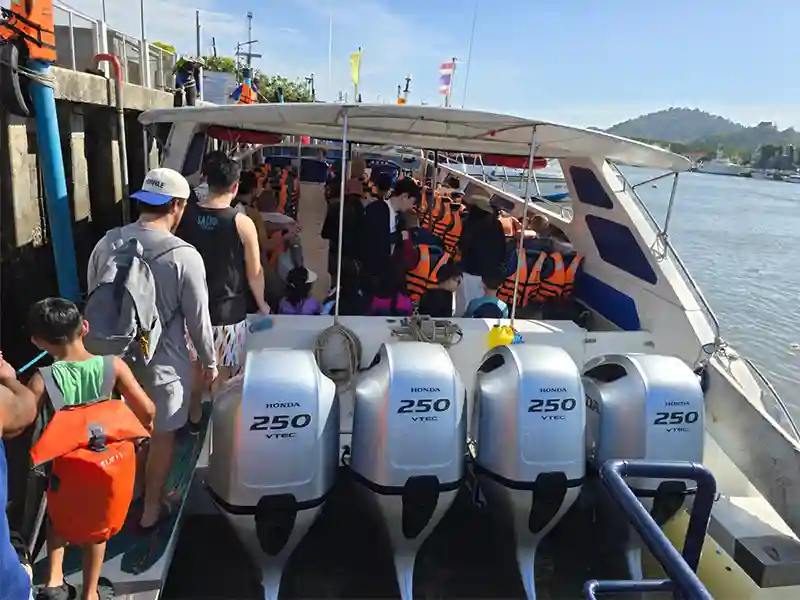
Speedboats are built for agility, featuring compact, forward-facing seats in a shared open-air cabin. Passengers must remain seated during the fast and occasionally bumpy ride. Luggage space is highly restricted, and large suitcases must be stacked in the front bow.
Best Phuket Ferry Companies (2026 Comparison)
We partner with the most trusted, fully-licensed marine operators at Rassada Pier. Here is a quick guide to help you choose the right company for your transfer.
Phi Phi Cruiser
Top Recommended
What is the best ferry from Phuket to Phi Phi?
“Phi Phi Cruiser is the best ferry from Phuket to Phi Phi, offering spacious air-con cabins and great value.”
Large open-air sun deck
Spacious air-conditioned cabins
Best choice for comfort & budget
Phi Phi Logistic
Speed & Efficiency
Specializing in fast speedboat transfers. This operator is ideal for passengers who want to minimize transit time and maximize their hours on the beach.
Fastest 60-min crossings
Direct pier-to-pier routes
Modern speedboat fleet
Andaman Wave Master
Premium & Reliable
Renowned for their large, incredibly stable premium cruisers. The best choice for passengers prone to seasickness or those carrying heavy luggage to Phi Phi.
Premium VIP seating available
Very stable in choppy waters
Excellent safety record
🌊
Monsoon Season Advice
“To avoid rough seas during the May-October monsoon, we strongly recommend taking the large standard ferry.”
*All operators are fully licensed by the Thai Marine Department. Vessel assignments depend on daily weather conditions.
Standard pickup zones
Optional Shared Minivan Transfer to Rassada Pier
For hotels in Patong, Kata, Karon, Chalong and Phuket Town, select the Boat + Transfer option when booking. We confirm the boat and shared pickup together under the same reservation.
Select Boat + Transfer
Choose the combined option in the booking system. A boat-only selection does not add hotel pickup.
Confirm the hotel zone
Select the correct hotel and area so the system can display the available pickup arrangement.
Standard-zone pickup time
For an 08:30 ferry, pickup is normally scheduled between 07:00 and 07:30. Follow the confirmed time shown on your ticket.
150 THB transfer fee
Shared minivan pickup costs an additional 150 THB per person, one way.
What the fee covers
The 150 THB charge covers the road transfer only. Your final checkout total includes both the boat fare and transfer fee.
Extended pickup zones
Extended-Area Pickup and Transfer Surcharges
Hotels in Panwa, Kamala, Bang Tao, Surin and Nai Yang Beach require an extended-zone selection. We calculate the pickup arrangement from the exact hotel location entered during booking.
Select the exact location
Choose the correct hotel zone in the booking system to see the applicable transfer option and charge.
Extended-area surcharge
The additional road-transfer charge ranges from 250 to 1,200 THB. Depending on the location, it may apply per person or per private vehicle.
Earlier pickup time
For an 08:30 ferry, be ready in the hotel lobby between 06:30 and 07:00. Use the exact pickup time confirmed on your ticket.
One combined booking total
The booking system combines the boat fare and the applicable extended-area transfer charge into one final total. The boat and hotel pickup are confirmed together under the same reservation.
Shared pickup planning
Transfer Booking Deadlines and Cut-Off Times
Your boat ticket and shared hotel pickup are booked together under the same reservation. We use the following cut-off times to arrange and confirm the shared pickup service.
01
Allow 24–48 hours
Book shared minivan pickup at least 24 hours before departure. Some routes require up to 48 hours because vehicles and pickup sequences are allocated in advance.
02
18:00 is the final cut-off
For 2026 bookings, the next morning’s shared pickup plan closes at 18:00. Requests received later cannot be added, even when boat seats remain available.
03
Late booking means self-transit
If you book a next-morning boat ticket after 18:00, hotel pickup is unavailable. Arrange your own local transport and travel directly to the departure pier for check-in.
🚐 How to Get to the Phuket Ferry Terminal (Rassada Pier)
Phuket Ferry Terminal (Rassada Pier) is the primary departure hub for all passenger ferries and speedboats. Located just 5 kilometers (15 minutes) east of Phuket Old Town, the terminal is easily accessible via local taxi, ride-hailing apps, or rental car. Use the map and transport guide below to plan your arrival.
Essential Terminal Guide
📍 Location:Moo 7, Rassada, Mueang Phuket District, Phuket 83000. Searchable on Google Maps, Apple Maps, and Yandex.
🕒 Opening Hours:The terminal is open daily from 07:30 to 18:00.
🚕 Transport Options:Accessible via local taxis and ride-hailing apps (Grab, Bolt, InDrive). Public transit: PPAO EV Bus Route 3 (Green Line) serves Rassada Pier. View EV Bus details.
🚗 Estimated Drive Times:Phuket Old Town: 15 mins (5 km). Patong Beach: 45 mins (20 km). Phuket Airport: 90 mins (35 km). Travel times vary based on road congestion.
🅿️ Facilities & Parking:Secure, paid overnight parking is available. The terminal features a waiting lounge, restrooms, and snack kiosks.
🎟️ Ticketing Advice:Walk-in tickets are subject to vessel capacity limits. Pre-booking online is strongly advised to guarantee seats, as popular routes sell out frequently.
⏰ Check-in Time:Arrive 30 to 45 minutes before departure to complete check-in procedures and board your vessel comfortably.
Local transport reality check
Does the Phuket EV Bus stop at Rassada Pier?
Yes. PPAO EV Bus Route 3, shown as the green line, serves Rassada Pier. When this information was checked on 10 September 2026, the published fare was 15 THB for the full route.
PPAO EV Bus · Phuket PPAO EV Bus in Phuket.
I treat the EV Bus as a useful local transport option, not as a guarantee that a passenger will make the boat. Check the current route before leaving, then work backward from the ferry boat's check-in cut-off. I would plan to be inside the terminal 30 to 45 minutes before departure. If the next bus leaves too little margin, take a taxi or a ride-hailing car.
Route
Route 3 · Green line
Published fare
15 THB · Full route
Boat buffer
Arrive 30–45 min early
“I check the EV Bus route and the ferry boat's check-in time together. A low bus fare only helps when there is enough time to board.”
PHUKET FERRY TO PHI PHI -- ON-SITE VISUAL GUIDE
Best Ferry from Phuket to Phi Phi (Real Terminal & Boat Photos)
Explore authentic on-site photos of the Phuket ferry terminal at Rassada Pier, Phi Phi Cruiser check-in counters, air-conditioned cabins, and decks to choose the best ferry from Phuket to Phi Phi.
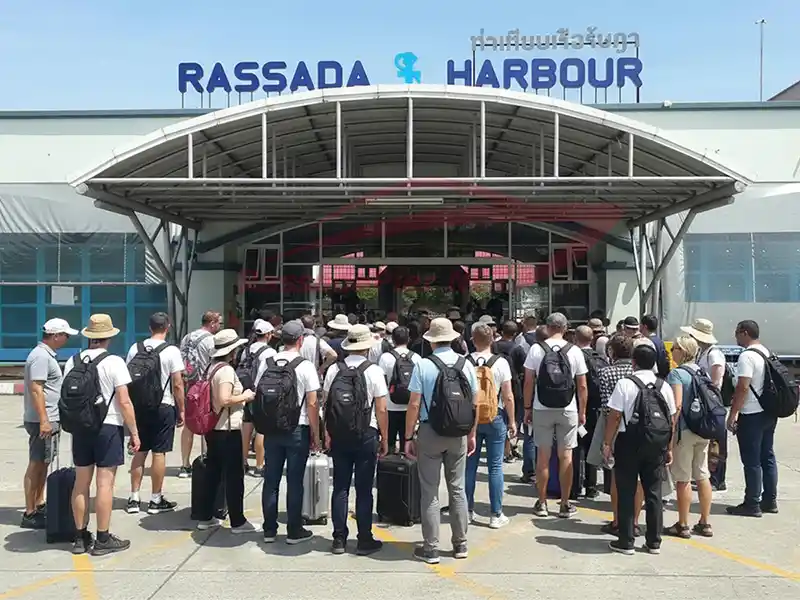
01 Tourists with luggage waiting at the main entrance of Rassada Pier (Phuket Ferry Terminal) before departure.
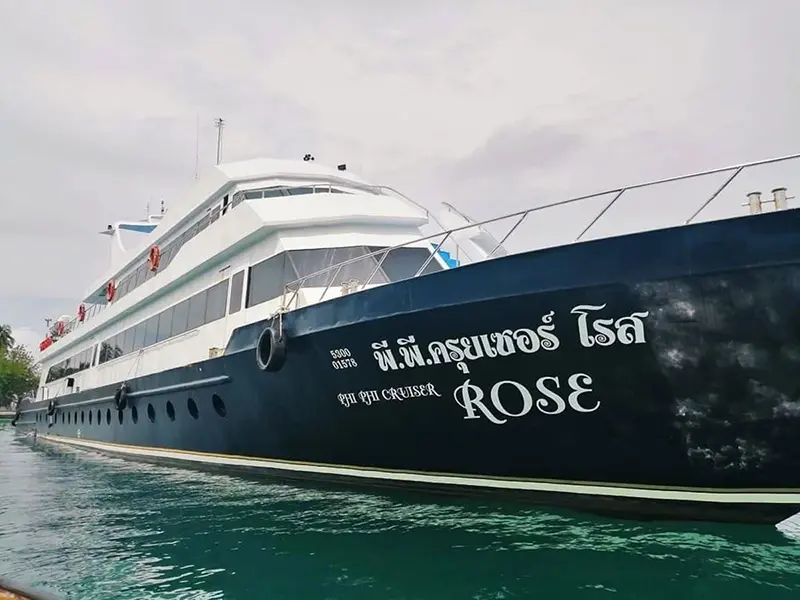
03 Phi Phi Cruiser Rose standard ferry docked at Rassada Pier, operating the route between Phuket and Koh Phi Phi.
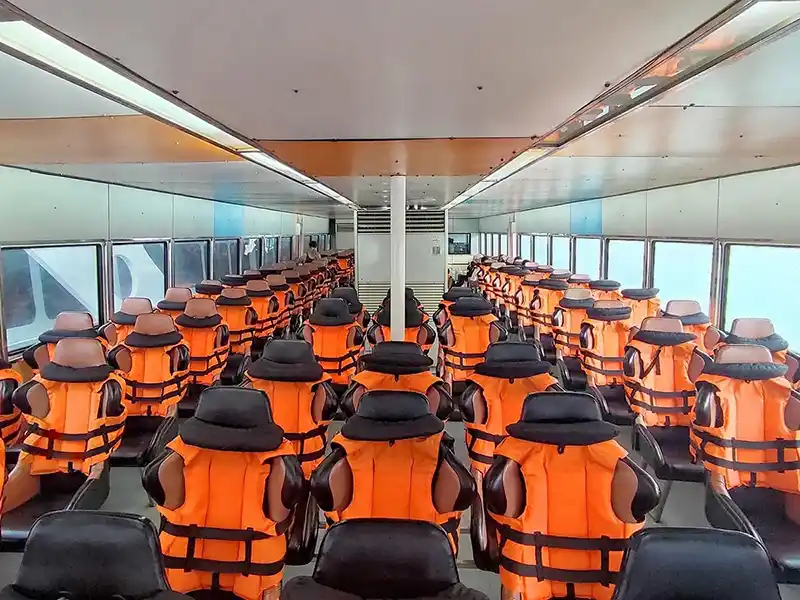
04 Interior air-conditioned passenger cabin of the Phi Phi Cruiser standard ferry showing rows of seats equipped with orange life jackets.
05 Passengers relaxing on the shaded outdoor deck of the Phi Phi Cruiser standard ferry during the trip to Koh Phi Phi.
06 Tourists relaxing and sunbathing on the open-air top sun deck of the Phi Phi Cruiser ferry during the trip to Koh Phi Phi.
ⓘ Authentic visual guide for passengers taking a Phuket ferry to Koh Phi Phi. Verified on-site at Rassada Pier by Ted Li, Head of Product Operations.
On-site boarding process
Rassada Pier Check-In: Four Steps Before Boarding
The counter number, boarding sticker and gate are assigned to a specific departure. Keep the e-ticket available and follow those details in order.
On-site examples of operator counters and passenger check-in at Rassada Pier. The assigned counter depends on the booked operator and departure.
Before arriving: A confirmed e-ticket lets passengers go to the assigned operator counter instead of purchasing a ticket at the pier. Check-in queues may still form before busy departures.
Arrive 45 minutes before departure
Go inside the main terminal and use the counter printed on the e-ticket. Allow the full 45 minutes; reaching the building at the scheduled boat time is already late.
Match the operator and counter
Check the operator name and counter number before joining a queue. Show the digital e-ticket on a phone. A paper copy is normally unnecessary unless the ticket states otherwise.
Keep the boarding sticker visible
After the booking is confirmed, staff issue a colored sticker linked to the assigned vessel and destination. Keep it visible until boarding is complete.
Wait for the sticker-color call
Remain in the waiting area until staff call the sticker color and direct passengers to the correct gate. Do not change queues based only on the destination name.
⚠️ Local Requirement: Koh Phi Phi Island Entry Fees
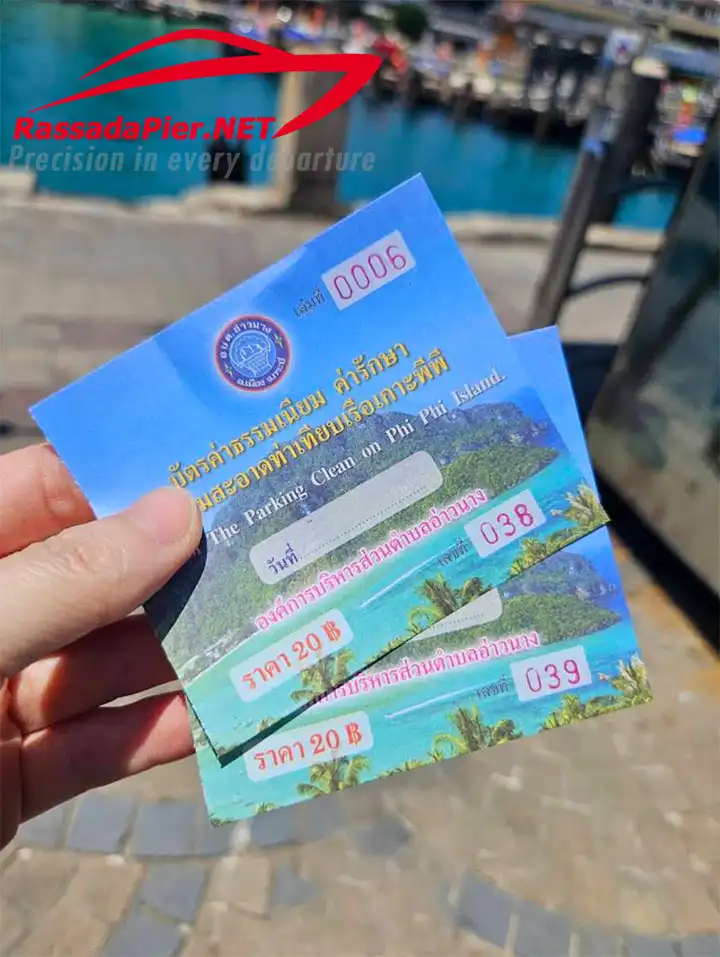
Upon arrival at Tonsai Pier, every visitor is required to pay a mandatory 20 THB local cleaning fee in cash. Additionally, if you plan to visit the National Park areas, such as Maya Bay, an extra fee of 400 THB per adult applies. Please ensure you have sufficient Thai Baht prepared in advance, as credit cards are not accepted for these specific island charges.
The Top Frequent Queries About Phuket Ferry
1. Where does the Phuket ferry depart from?
All our boats depart from the main Phuket Ferry Terminal (also known locally as Rassada Pier). It is located just 15 minutes from Phuket Old Town. We recommend checking your specific Phuket ferry schedule and arriving at the terminal at least 45 minutes before departure.
2. Where do boats from the Phuket Ferry Terminal go?
The main Phuket Ferry Terminal (Rassada Pier) is the central hub connecting you to top Andaman islands. You can catch a Phuket Ferry to Koh Phi Phi, Krabi (Ao Nang), Railay Beach, and Koh Lanta. Check our Phuket ferry schedule for daily departures.
3. How long does the ferry to Koh Phi Phi from Phuket take?
The standard ferry to Koh Phi Phi from Phuket takes approximately 2 hours for a scenic cruise. If you want to get there faster, the speedboat takes just 60 minutes. Because the ferry Phi Phi Phuket route is extremely popular year-round, Phi Phi ferry tickets often sell out at the pier, so pre-booking is essential.
4. How much is the Phuket ferry price for Koh Phi Phi?
The standard Phuket ferry price starts at 650 THB per adult. Fast speedboat phi phi ferry tickets range from 800 to 900 THB per adult. We highly recommend early Thailand ferry booking online to secure the best rates.
5. Can I buy my Thailand phuket ferry booking directly at the pier?
While walk-in tickets are sold at standard counter rates, boats frequently sell out. Cash is useless if the boat has reached safety capacity. Checking the Phuket ferry schedule and completing your Thailand phuket ferry booking online is the only safe way to guarantee your spot.
6. What is the baggage allowance for passengers?
Your ticket includes a maximum combined baggage limit of 25 kg per person, which covers one main suitcase and one small carry-on item. Please note that bags exceeding this weight restriction might be subject to additional surcharges at the pier.
7. What time should I get to the terminal for my ferry?
To ensure a smooth check-in and boarding process, please make sure you are at the pier no less than 45 minutes prior to your boat's departure time.